Career in Metallurgy Engineering – Scope, Opportunities, and Institutes in India
Career in Metallurgy Engineering – Scope, Opportunities, and Institutes in India
By Test Hub | November 12, 2025 | 5 Mins Read
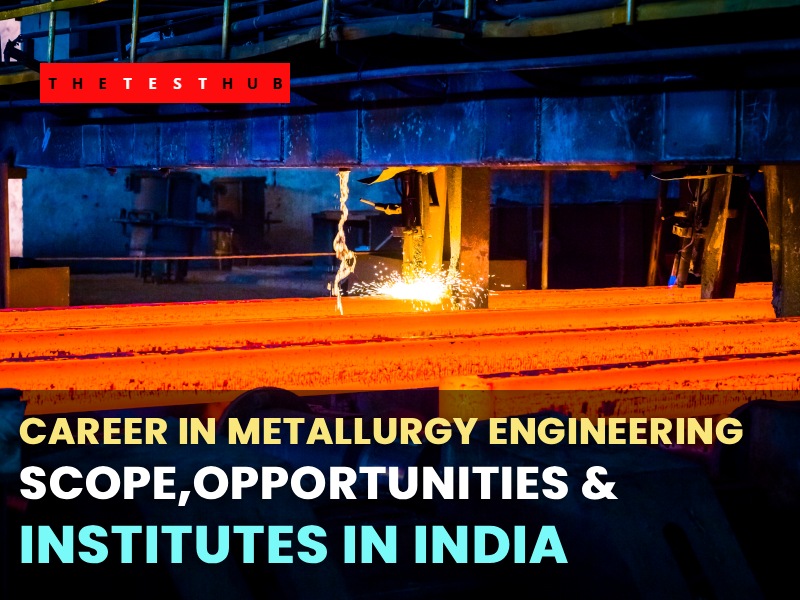
A career in Metallurgy Engineering offers exciting opportunities for those interested in studying metals, their properties, and their applications across industries. As a branch of materials science and engineering, metallurgy focuses on the physical and chemical behavior of metallic elements and alloys, forming the backbone of industries like aerospace, automotive, energy, and manufacturing. Understanding this field can open the door to a rewarding and technologically advanced profession.
A career in Metallurgy Engineering involves studying metals, their extraction, processing, and applications in industries. Graduates can work in sectors like mining, manufacturing, and aerospace or pursue advanced research. Top Indian institutes offering metallurgy programs include IIT Roorkee, NIT Tiruchirappalli, and IIEST Shibpur.
Key Points:
-
Focuses on metal properties, extraction, and processing
-
Core sectors: Manufacturing, Aerospace, Automotive, and Research
-
Courses: B.Tech in Metallurgy, M.Tech in Material Science
-
Eligibility: 10+2 with Physics, Chemistry, and Mathematics
Understanding Metallurgy Engineering
Metallurgy Engineering is a specialized branch of materials science and materials engineering that studies the chemical and physical behavior of metallic elements and their alloys. The discipline blends theoretical science with practical application, helping engineers design, process, and improve materials used in every industrial domain.
Metallurgists play a crucial role in developing stronger, lighter, and more durable metals for technology-driven applications. Whether it’s building aircraft engines or developing corrosion-resistant structures, metallurgists are vital to innovation.
Courses in Metallurgy Engineering
Undergraduate Courses
1. Bachelor of Technology (B.Tech.) in Metallurgy and Materials Engineering – This four-year program introduces students to metal extraction, alloy development, and material testing techniques.
2. Bachelor of Engineering (B.E.) in Metallurgical or Materials Engineering – Offers similar core subjects with added focus on industrial applications and metal manufacturing processes.
Postgraduate Courses
1. Master of Technology (M.Tech.) in Material Science and Engineering – This program delves deeper into materials characterization, nanomaterials, and research methodologies.
2. Eligibility: Candidates must hold a B.E./B.Tech. or equivalent degree in Metallurgical, Materials, Mechanical, Production, or Ceramics Engineering.
Eligibility Criteria
To pursue a career in Metallurgy Engineering, students must meet the following eligibility requirements:
Completion of 10+2 with Physics, Chemistry, and Mathematics.
Admission to B.Tech programs usually requires qualifying in entrance exams like JEE Main or JEE Advanced.
For M.Tech programs, candidates typically need a valid GATE score in a relevant discipline.
Top Institutes Offering Metallurgy Engineering in India
Several prestigious institutions in India provide high-quality education in Metallurgy Engineering. Some of the best are:
-
Indian Institute of Technology (IIT), Roorkee
-
Indian Institute of Technology (BHU), Varanasi
-
National Institute of Technology (NIT), Tiruchirappalli
-
Indian Institute of Engineering Science and Technology (IIEST), Shibpur, West Bengal
-
Government College of Engineering, Salem, Tamil Nadu
-
College of Engineering, Pune, Maharashtra
-
Government Engineering College, Gandhinagar, Gujarat
These institutions are known for their robust curriculum, industry exposure, and advanced research facilities that prepare students for both professional and academic excellence.
Career Opportunities in Metallurgy Engineering
A career in Metallurgy Engineering spans multiple industries. Graduates can explore diverse roles such as:
-
Process Engineer – Overseeing metal refining and manufacturing processes.
-
Materials Engineer – Developing and testing new metal alloys.
-
Quality Control Engineer – Ensuring material strength, durability, and compliance.
-
Research Scientist – Innovating in advanced materials and nanotechnology.
-
Production Engineer – Managing large-scale metal fabrication units.
Industries Hiring Metallurgy Engineers
-
Steel and Aluminum Manufacturing
-
Automotive and Aerospace
-
Mining and Mineral Processing
-
Energy and Power Plants
-
Defense and Research Organizations
Skills Required for Success
To build a strong career in Metallurgy Engineering, professionals should develop a blend of technical and analytical abilities, such as:
-
In-depth knowledge of physical metallurgy and thermodynamics
-
Problem-solving and critical thinking
-
Laboratory and material testing expertise
-
Research and innovation mindset
-
Strong mathematical and computational skills
Commonly Asked by Users
Q1. What is the scope of a career in Metallurgy Engineering in India?
The scope of a career in Metallurgy Engineering is broad, spanning from industrial manufacturing to high-end research. Engineers are in demand in public and private sectors, especially in steel, mining, aerospace, and automotive industries.
Q2. Which are the best colleges for Metallurgy Engineering in India?
Top colleges include IIT Roorkee, NIT Tiruchirappalli, and IIEST Shibpur, known for their world-class faculty, laboratories, and placement records.
Q3. What subjects are important for Metallurgy Engineering?
Core subjects include Physics, Chemistry, Mathematics, Thermodynamics, Material Science, and Metallurgical Processes.
A career in Metallurgy Engineering offers immense growth opportunities in India’s industrial and research sectors. With continuous advancements in materials technology, metallurgists will play a pivotal role in shaping innovations across industries. For students passionate about metals, materials, and modern engineering, this field promises a bright and impactful future.
Disclaimer The information provided in this blog is for general guidance only. Readers are advised to verify facts independently before making any decisions.
Explore More Resources
If you are preparing for entrance exams, internships, placement drives, or interviews, don’t miss out on valuable study materials, practice questions, and guidance.
Visit [The Test Hub](https://www.thetesthub.com/category/all/) to boost your preparation and achieve your goals.
Share this post:



Recent Article




Related Posts

Career in Physical Sciences: Scope, Opportunities & Top Institutes
A career in Physical Sciences offers a deep understanding of the natural world by studying ...
Read More
Career in Naval Architecture Engineering
A Career in Naval Architecture Engineering offers exciting opportunities for those fascinated by the design ...
Read More
Career in Mining Engineering: Scope, Courses, and Top Institutes in India
A career in Mining Engineering offers a unique blend of science, technology, and environmental management. ...
Read More
INSTRUMENTATION ENGINEERING Scope, Career Opportunities, Institutes in India
Instrumentation Engineering is a specialized branch of electrical and electronics engineering that focuses on the ...
Read More